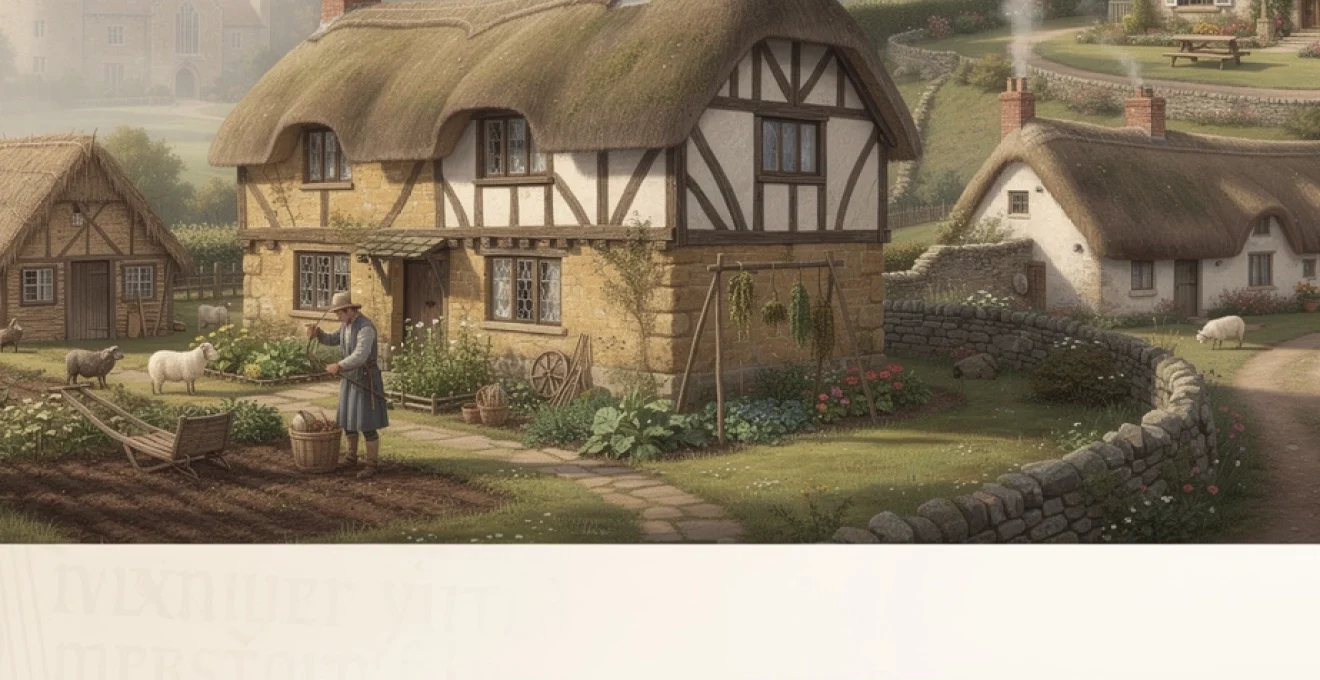
The word “cottage” conjures vivid images of quaint rural dwellings nestled beneath thatched roofs, surrounded by wildflower gardens and hedgerows. Yet this familiar term carries a complex history spanning nearly a millennium, rooted in Anglo-Saxon settlements and shaped by Norman legal frameworks, Tudor legislation, and Victorian romanticism. Understanding the etymological journey of “cottage” reveals how a simple descriptor for peasant housing evolved into a culturally loaded term encompassing everything from weekend retreats to architectural aesthetics. The linguistic transformation mirrors broader shifts in social hierarchies, land ownership, and cultural attitudes toward rural life, making “cottage” one of the most historically layered words in the English property lexicon.
Etymology and linguistic roots of the term ‘cottage’ in old english and norman french
The etymology of “cottage” provides a window into medieval social structures and the linguistic blending that defined Middle English. Tracing this word back to its earliest forms reveals how terminology for housing reflected rigid class distinctions and evolving legal concepts of property tenure.
The Anglo-Saxon ‘cot’ and its Proto-Germanic origins in medieval england
Before the Norman Conquest of 1066, Anglo-Saxon communities used the Old English word “cot” or “cote” to designate a modest shelter or hut, typically a single-room structure housing either animals or lower-status inhabitants. This term derived from Proto-Germanic “*kutą,” which scholars have connected to similar words across Germanic languages denoting basic enclosures or rudimentary dwellings. Archaeological evidence from pre-Norman England shows these “cots” were often constructed using readily available materials such as timber posts, woven hazel branches (wattles), and daub—a mixture of clay, dung, and straw that provided basic weatherproofing.
The simplicity of these structures reflected the subsistence-level existence of early medieval peasants, who required little more than protection from the elements and a hearth for cooking. The word “cot” carried no romantic connotations in Anglo-Saxon England; it was a functional descriptor for minimal accommodation, distinct from the “hall” or “burh” occupied by thegns and nobility. Linguistic analysis of surviving texts from this period, including land charters and legal documents, confirms that “cot” denoted the lowest tier of permanent dwellings, often provided to labourers who worked surrounding fields in exchange for basic shelter and subsistence rights.
Norman conquest influences: ‘cotage’ as a legal and social descriptor in feudal systems
The Norman Conquest fundamentally altered English land law and introduced French administrative vocabulary that would reshape property terminology. By the late 13th century, legal documents began employing “cotage” or “cotagium”—terms borrowed from Anglo-Norman French that combined “cot” with the suffix “-age,” denoting a collection, holding, or tenure arrangement. This linguistic innovation was more than cosmetic; it reflected the formalization of manorial systems where cottages became legally defined units tied to specific obligations and rights.
Under Norman-influenced feudal law, a “cottager” (or “cotter”) was a peasant of lower status than a villein, typically holding less than five acres and owing labour services to the lord of the manor. The Domesday Book of 1086, though not using “cottage” explicitly, enumerated numerous “bordars” and “cottars” whose dwellings would later be termed cottages in legal records. By the 14th century, manorial court rolls routinely distinguished cottages from messuages (larger farmsteads with more substantial acreage), establishing “cottage” as a precise legal category denoting both the physical structure and the tenurial relationship it represented.
Middle english transformations: phonetic evolution from ‘cotage’ to ‘cottage’ (1200-1500)
During the Middle English period (approximately 1150 to 1500), the spelling and pronunciation of “cotage” underwent gradual standardisation, eventually settling into the familiar “cottage” by the late 15th century. This phonetic shift followed broader patterns in Middle English, where the French-influenced “-age” suffix was fully naturalised into the language, appearing in words like “village,” “marriage,” and “
marriage.” Over time, scribes increasingly preferred the doubled “t” in “cottage,” reflecting both French orthographic influence and emerging patterns of English consonant doubling for short vowels, as in “butter” or “copper.”
By the 15th century, “cottage” appears with relative consistency in legal records, wills, and estate surveys, signalling that the term had fully entered the English vernacular as a stable lexical item. The shift from “cotage” to “cottage” might seem minor, but it marks the point at which an originally foreign-looking legalism became a familiar everyday word understood by speakers across regions and classes. In this period, “cottage” still carried clear associations with low-status housing and small-scale tenure, but its linguistic evolution laid the groundwork for later semantic expansion into architecture, aesthetics, and even tourism marketing.
Comparative analysis with european cognates: german ‘kotte’ and dutch ‘kot’
The word “cottage” does not exist in isolation within the European linguistic landscape. Its Germanic root “*kutą” produced a family of related terms across northern Europe, including German Kotte or Kotten and Dutch kot. In many dialects of German, especially in the Rhineland and Westphalia, Kotten historically denoted a small rural house occupied by a day labourer or smallholder, closely mirroring the English association with modest agricultural dwellings. Dutch kot, meanwhile, developed a broader, sometimes pejorative sense—meaning a shack, hovel, or cramped room, such as a student bedsit.
These cognates reveal how a single Proto-Germanic notion—a small enclosed shelter—was shaped by different legal and social environments. In England, the Norman layer of “cotage/cotagium” crystallised into a precise manorial category, while in German-speaking lands the term remained more descriptive and less tightly bound to formal tenurial law. Yet the semantic field remains strikingly consistent: all these words evoke simplicity, limited space, and often low social status. When we compare “cottage” to its continental cousins, we see that English is unusual not in the origin of the term, but in how thoroughly it later romanticised and commodified what started as a label for very basic housing.
Socioeconomic context of cottages in medieval britain and the peasant class
Understanding the origin and meaning of the word “cottage” also requires a close look at who actually lived in these buildings and how they fitted into the rural economy. In medieval Britain, cottages were not abstract architectural types; they were lived realities for a large segment of the peasant class. Their legal status, economic role, and relationship to the land all contributed to the historical weight the term still carries today.
Cottagers and villeins: legal status under manorial law and land tenure systems
Within the manorial system, peasants were carefully differentiated according to the land they held and the services they owed. Villeins (or unfree tenants) typically held substantial strips of arable land in the open fields, along with rights to common pasture, in return for heavy labour obligations and dues. Cottagers or cotters, by contrast, occupied far smaller holdings—often just a house and tiny garden plot—and were usually ranked below villeins in manorial hierarchies. Their cottage might come with a sliver of land, but rarely enough to sustain a family without wage labour or supplementary work.
Manorial court rolls from the 13th to 15th centuries frequently list cottagers separately, recording fines, transfers of tenancies, and disputes over access to fuel or grazing. These documents show how closely the physical “cottage” was tied to legal identity: to be a cottager was not simply to live in a small house, but to occupy a defined rung in the social ladder. You owed certain days of service at harvest, perhaps carting manure or hedging fields, and you could be evicted if you failed to perform. In this sense, the word “cottage” encoded a whole bundle of rights and obligations, much like a modern employment contract includes both salary and conditions.
The cottage economy: small-scale agriculture and domestic production in 14th century england
Economically, cottages functioned as micro-hubs of mixed subsistence and market activity. While a cottager’s strip of land might be small, the attached garden (or croft) was intensively cultivated with vegetables, herbs, and sometimes flax or hemp. A pig tethered nearby, a few chickens, and rights to glean after the harvest could make the difference between survival and destitution. Studies of late medieval households suggest that many cottagers combined agricultural day labour with domestic craftwork, such as spinning, weaving, or brewing ale for sale.
This “cottage economy” foreshadowed later cottage industries. Merchants would sometimes distribute raw wool or yarn to rural households, who spun or wove it in their own cottages before returning finished cloth for payment. In this way, the cottage became both home and workshop, blurring the line between domestic and economic space. If we think of modern remote workers setting up laptops on kitchen tables, the analogy is striking: the structure of the cottage enabled flexible, home-based labour long before digital technology, and the word itself later migrated into terms like “cottage industry” to describe precisely this kind of distributed production.
Parliamentary acts and cottage regulations: the 1589 cottage act under elizabeth I
By the late 16th century, rapid demographic growth and pressure on common land led the Tudor state to intervene directly in how and where cottages could be built. The 1589 Cottage Act under Elizabeth I attempted to regulate the proliferation of new cottages by insisting that any newly erected cottage must be accompanied by at least four acres of land. The aim was clear: prevent the emergence of landless, impoverished households who might become a burden on parish poor relief. A cottage, in law, was supposed to be tied to enough land to support its occupants.
There were notable exemptions for certain categories of workers, including miners, industrial labourers, and sometimes estate employees, reflecting the growing importance of non-agrarian occupations. Manor surveys from places like Settrington in Yorkshire show how these regulations interacted with local practice, distinguishing “cottages” without common rights from more substantial “husbandries” or “grass farms.” The Cottage Act did not eliminate poverty, but it shows how intensely the state scrutinised the relationship between a physical cottage, its acreage, and the social status of its occupants. For historians of housing, this statute marks an important moment when “cottage” became a target of national policy, not just a manorial label.
Architectural typology: traditional cottage construction methods and regional variations
Beyond legal definitions and social hierarchies, the history of the word “cottage” is also written in timber, stone, and thatch. Traditional cottage architecture in Britain was profoundly local, shaped by available materials, climate, and building customs. Yet, certain core construction methods recur from county to county, giving us a recognisable “cottage” typology even amid striking regional variety.
Cruck frame construction and wattle-and-daub techniques in vernacular architecture
One of the most distinctive structural systems used in medieval and early modern cottages is the cruck frame. In this method, pairs of curved oak timbers—often split from a single tree—were set opposite each other to form A-shaped frames rising from ground to roof ridge. These cruck blades created a strong internal skeleton that could support roof loads without the need for thick stone walls. Between the frames, builders inserted lighter timber studs and filled the spaces with wattle-and-daub: woven hazel or willow rods plastered with a mixture of clay, straw, and animal dung.
From a modern perspective, wattle-and-daub might seem primitive, yet it offered good insulation and used entirely local, renewable materials. It was also repairable: daub could be patched after storms or cracking, much like we might repaint or re-plaster walls today. Many surviving medieval cottages in counties such as Herefordshire or Worcestershire reveal this cruck-and-daub system beneath later alterations. When you hear the word “cottage” and imagine low, irregular walls and slightly sagging roofs, you are, in effect, picturing the physical legacy of these vernacular techniques.
Regional cottage styles: cotswold stone, devon cob, and welsh longhouses
Regional geology left a strong imprint on the look and feel of traditional cottages. In the Cotswolds, abundant oolitic limestone was quarried and laid in distinctive warm honey-coloured blocks, creating the postcard-perfect Cotswold stone cottage with steep gables and mullioned windows. These buildings often combined stone walls with stone slate roofs, heavy enough to require robust timber framing but remarkably durable, many surviving from the 17th century or earlier.
Further southwest in Devon and parts of Cornwall, a different vernacular dominated: cob. Cob is a mixture of subsoil, straw, and water, piled and compacted to form thick, monolithic walls sometimes exceeding half a metre in thickness. Whitewashed for weather protection, Devon cob cottages have a soft, rounded appearance, their windows and doors set deep into the mass of the wall. In Wales, especially in the west, longhouses developed—a single elongated structure under one roof, historically shared by people and animals. These Welsh longhouse cottages, built of rubble stone with slate roofs, oriented the doorway along the long side and organised interior space linearly, reflecting both practical needs and cultural preferences for integrated farmsteads.
Thatched roofing and timber-framing: material culture of the english countryside
No discussion of cottage architecture is complete without thatch. For centuries, thatched roofs made from long straw or water reed were the default covering for rural cottages across much of England. Thatch provided excellent thermal performance, keeping interiors cool in summer and warm in winter, and could be laid on relatively lightweight roof structures. Its thick, textured surface also gave cottages their iconic, storybook silhouette—curving over low eaves and sometimes dipping to meet the tops of ground-floor windows.
Timber-framing, especially in regions rich in woodland, complemented thatch. Exposed oak beams with infill panels of wattle-and-daub or later brickwork created the black-and-white cottages typical of counties like Cheshire and Shropshire. These visible frames were not originally decorative; they were simply the structure revealed. However, as centuries passed, the exposed timbers themselves became a visual shorthand for antiquity and rural authenticity. When modern developers describe a property as a “timber-framed cottage” in sales listings, they are drawing on this long material tradition to signal age, craftsmanship, and a particular countryside aesthetic.
The scottish crofter’s cottage: highland blackhouses and hebridean building traditions
North of the English border, the cottage took on forms shaped by harsher climates and different social arrangements. In the Highlands and Islands of Scotland, the traditional “blackhouse” was a low, thick-walled dwelling built of stone and turf, often with a thatched roof weighted down by ropes and stones against Atlantic gales. Smoke from the central hearth escaped through the thatch, staining interior rafters and lending the “blackhouse” its name. Animals might be housed in one end of the building, humans in the other, sharing warmth through the massive, insulating walls.
These crofter’s cottages reflected a way of life based on small-scale tenant farming, fishing, and seasonal labour, often under the harsh constraints of landlord control and later clearance. While very different in appearance from an English thatched cottage in, say, Suffolk, they shared key characteristics: modest scale, close tie to the land, and construction from immediately available materials. Today, restored blackhouses in places like the Hebrides have become heritage attractions and holiday lets, illustrating once again how a dwelling type born of necessity can be reinterpreted as an object of fascination and comfort centuries later.
Romantic reinterpretation: the cottage ornée and picturesque movement (1790-1850)
By the late 18th century, social elites and architects began to look at humble cottages with new eyes. Industrialisation, urban growth, and changing aesthetic tastes sparked a reaction that idealised rustic simplicity. The “cottage ornée”—literally “ornamented cottage”—emerged as a designed, often luxurious building that borrowed the forms of peasant housing while overlaying them with picturesque detail. The meaning of “cottage” expanded: no longer just a poor labourer’s dwelling, it could now describe an intentional retreat for the wealthy, crafted to look charmingly simple.
John nash’s blaise hamlet and the idealisation of rural poverty
One of the most famous examples of this romantic turn is Blaise Hamlet near Bristol, designed by John Nash around 1810 for retired employees of the Blaise Castle estate. The nine cottages that cluster around a central green are deliberately irregular: thatched roofs with sweeping curves, tall chimneys, diamond-paned windows, and overgrown gardens contrive an image of timeless rusticity. Yet these were not organic medieval survivals; they were carefully composed pieces of picturesque architecture built in an era of canals, factories, and expanding cities.
Blaise Hamlet illustrates a subtle but important shift in the cultural meaning of “cottage.” Poverty and low status were aestheticised, turned into a kind of architectural costume. The labourer’s cramped reality—damp floors, smoke-blackened interiors, overcrowding—was edited out, replaced by neat bench seats, climbing roses, and cosy interiors. When we talk today about a “chocolate-box cottage” on a calendar or biscuit tin, we are echoing this early 19th-century habit of turning rural hardship into decorative charm.
Literary influence: william wordsworth’s dove cottage and the lake district aesthetic
Literature reinforced this romanticised vision. William Wordsworth’s residence at Dove Cottage in Grasmere, a modest former inn with whitewashed stone walls and a slate roof, became a symbol of the Lake District’s poetic landscape. In his poetry and later reflections, Wordsworth presented the cottage as a place of retreat, contemplation, and closeness to nature. The sheer ordinariness of the building—small rooms, low ceilings, simple finishes—was recast as a virtue, a counterpoint to the artificiality and bustle of London or industrial towns.
Visitors soon flocked to see Dove Cottage and other “poets’ cottages” in the region, linking literary pilgrimage with cottage tourism. Guidebooks began to use “cottage” as shorthand for a certain kind of authentic, unspoiled dwelling enmeshed in dramatic scenery. This association between the cottage and emotional escape still shapes how the word is used in travel brochures and property descriptions, where phrases like “romantic stone cottage in the Lakes” promise not just accommodation but a Wordsworthian experience of place.
Pattern books and architectural guides: J.C. loudon’s encyclopedia of cottage architecture
The romantic fascination with cottages did not stay confined to poets and aristocratic patrons. In the early 19th century, architectural writers such as John Claudius Loudon published pattern books that brought cottage design into the realm of practical planning. Loudon’s Encyclopaedia of Cottage, Farm, and Villa Architecture (1833) offered detailed plans, elevations, and advice for building everything from basic labourers’ cottages to more elaborate “cottages ornées” for the middle classes.
These pattern books did two things at once: they codified a visual language of the “ideal cottage”—steep roofs, asymmetrical layouts, porches, and garden fronts—and they blurred the boundary between functional rural housing and aspirational suburban dwellings. A merchant in a growing town could commission a “cottage” that looked rustic but incorporated the comforts and proportions of a villa. In effect, the word “cottage” was beginning to detach from strict economic status and attach itself to a style, a look that could be reproduced far from the fields where the term had originated.
Victorian transformation: estate cottages and industrial worker housing
The Victorian era accelerated these trends while adding new layers of social control and industrial pragmatism. Large landowners across Britain undertook building programmes to provide “model” cottages for estate workers, designed to express paternalistic concern and moral order. These estate cottages often followed standardised plans with two or three bedrooms, a scullery, and sometimes a privy or wash-house, reflecting contemporary ideas about hygiene and respectability.
At the same time, industrialists in rapidly expanding towns borrowed the cottage label for rows of terraced worker housing, especially when these units included small front gardens or modest decorative features. A two-up, two-down brick house on the edge of a mill town might be described as a “cottage” in company documents or promotional literature, even though it bore little resemblance to the detached rural dwellings of previous centuries. Here, “cottage” suggested modesty and domestic virtue rather than specific construction methods or tenure types.
Philanthropic housing societies and reformers, influenced by both sanitary science and moral anxieties, promoted “cottage estates” as healthier alternatives to overcrowded courts and alleys. The word carried a strong prescriptive charge: a cottage was the proper setting for a disciplined working-class family, removed from the temptations of urban vice and overseen—at least indirectly—by employers or landlords. By 1900, “cottage” could signal both a picturesque rural dwelling and a unit in a carefully planned industrial suburb, further stretching the term’s semantic range.
Contemporary semantics: ‘cottage’ in modern british property lexicon and tourism marketing
In the 20th and 21st centuries, the meaning of “cottage” has continued to evolve, shaped by planning policy, the property market, and the rise of mass tourism. While many traditional cottages still function as primary homes in rural communities, the word itself is increasingly associated with lifestyle, leisure, and branding. Estate agents, holiday rental platforms, and social media all deploy “cottage” as a keyword loaded with promise: of cosiness, heritage, and escape from everyday pressures.
Holiday cottage industry: airbnb, sykes cottages, and the commodification of rural nostalgia
The modern holiday cottage industry in Britain exemplifies how a historical housing type can become a commercial asset. Companies such as Sykes Cottages, rural-focused agencies, and global platforms like Airbnb list tens of thousands of properties marketed as “cottages,” from genuine 17th-century thatched dwellings to newly built lodges dressed up with rustic decor. During the COVID-19 pandemic and its aftermath, demand for self-contained rural accommodation surged, with some regions reporting double-digit percentage increases in bookings as travellers sought safer, nature-focused breaks.
In this context, “cottage” operates as a powerful marketing term rather than a strict architectural description. A compact coastal bungalow or a converted barn may be advertised as a “cottage” if it fits the desired narrative of seclusion and simplicity. When you browse listings promising “romantic stone cottage with hot tub” or “dog-friendly cottage near the moors,” you are encountering a highly curated version of cottage history—a blend of genuine vernacular heritage and carefully staged nostalgia. The economic implications are significant: rising demand for holiday cottages can inflate rural property prices, making it harder for local residents to access traditional housing stock.
Conservation areas and listed buildings: national trust properties and heritage preservation
Alongside commercialisation, there has been a strong movement to protect and preserve historic cottages as part of Britain’s built heritage. Many notable examples—such as Anne Hathaway’s Cottage at Shottery or the cluster at Blaise Hamlet—are now managed by organisations like the National Trust or local heritage bodies. These properties are often Grade II or Grade II* listed, meaning any alteration is tightly controlled to safeguard original fabric, from thatched roofs to casement windows.
Conservation areas in villages across England, Scotland, and Wales frequently centre on groups of traditional cottages whose collective character is deemed worth preserving. Planning regulations may restrict materials, extensions, or even paint colours to maintain a coherent visual identity. For owners, this can be both a privilege and a challenge: living in a historic cottage brings cachet and often higher valuations, but also obligations and costs. Yet heritage protections also help ensure that the word “cottage” continues to refer, at least in part, to tangible, centuries-old buildings, not just to a decorative style applied to any small house.
Cottage core aesthetics: digital age rebranding and social media influence on linguistic usage
In the digital age, the cultural meaning of “cottage” has expanded again through the rise of “cottagecore,” an online aesthetic that romanticises pastoral living, home baking, crafting, and vintage interiors. On platforms like Instagram, TikTok, and Pinterest, millions of posts tagged with cottagecore feature gingham curtains, wildflower gardens, second-hand crockery, and, of course, idyllic cottages—sometimes real, sometimes imagined. The cottage here becomes less a specific building type and more a visual and emotional shorthand for slowness, self-sufficiency, and escape from digital overload.
This trend has begun to shape everyday language. You might hear younger speakers talk about “cottagecore vibes” in a city flat filled with houseplants, or brands marketing “cottage-style” clothing, fragrances, and homewares. In property listings and tourism marketing, phrases like “cottagecore retreat” tap into this online discourse to attract a global audience. While some critics argue that cottagecore glosses over the historical hardships of rural life—much as the picturesque movement did two centuries earlier—it also highlights how resilient and adaptable the word “cottage” has been. From medieval cottars’ huts to curated Instagram feeds, the term continues to carry rich layers of history, fantasy, and aspiration every time we use it.