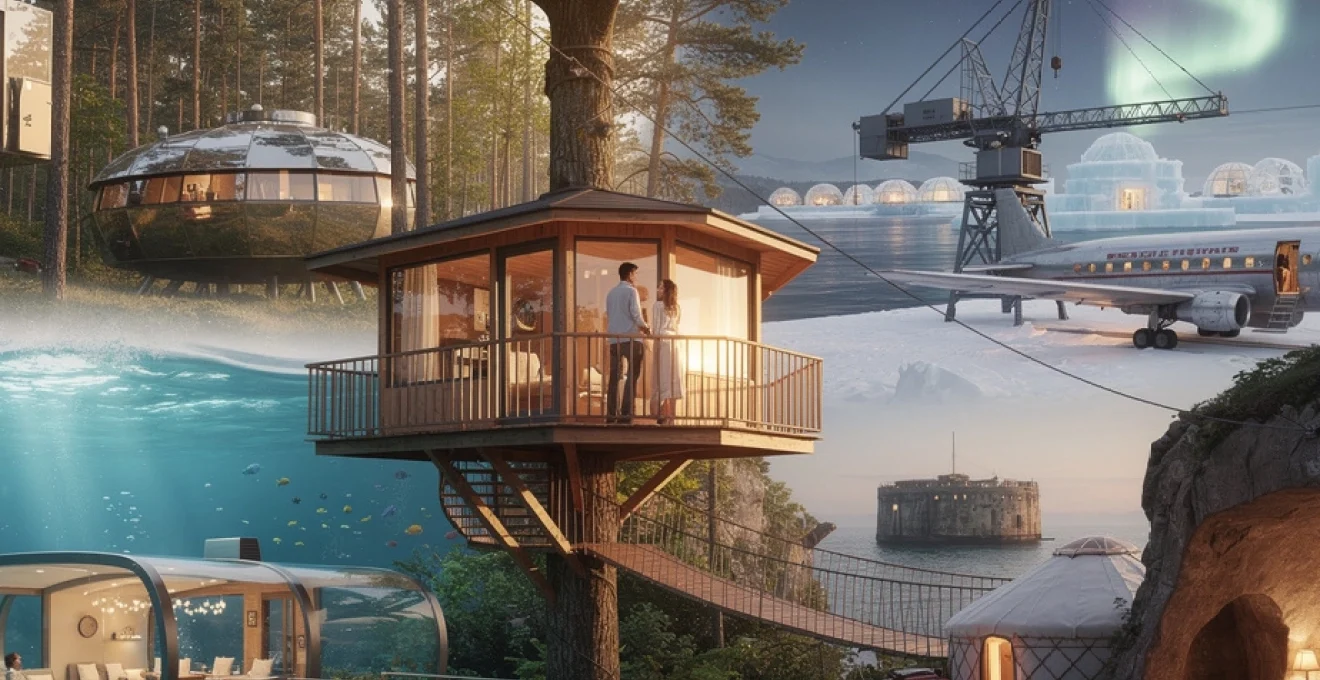
The hospitality landscape has evolved dramatically beyond traditional hotels and bed-and-breakfasts. Today’s travellers increasingly seek accommodations that offer more than just a place to sleep—they want immersive experiences that become central to their journey’s narrative. From treehouses suspended in rainforest canopies to suites carved into ancient rock formations, unusual accommodations have transformed how we think about travel itself. These distinctive stays blend architectural innovation, historical preservation, and environmental integration to create memorable experiences that standard lodging simply cannot match.
The appeal of unconventional accommodations extends beyond novelty. They offer you authentic connections to landscapes, cultures, and architectural heritage that conventional hotels often insulate guests from. Whether it’s feeling the ocean currents gently rock your underwater room or experiencing the thermal stability of a cave dwelling carved centuries ago, these spaces engage your senses in ways that fundamentally alter your relationship with place and environment.
Treehouse accommodation architecture: elevated living in forest canopies
Treehouse accommodations represent one of the most sought-after forms of alternative lodging, combining childhood nostalgia with sophisticated architectural engineering. Modern canopy-level dwellings bear little resemblance to the rickety platforms of youth, instead incorporating structural systems that protect both guest safety and tree health. The design challenges are considerable: structures must account for tree growth patterns, wind loads at elevated heights, and seasonal movement whilst maintaining the organic aesthetic that makes them appealing.
Contemporary treehouse design employs specialised attachment systems that distribute weight across multiple support points without penetrating deep into living wood. Floating bracket assemblies and compression collars allow trees to continue their natural growth patterns whilst supporting substantial structures above. These engineering solutions have enabled the creation of multi-room facilities complete with modern amenities, all whilst minimising long-term impact on host trees.
Finca bellavista sustainable treehouse community in costa rica
Nestled within Costa Rica’s Pacific rainforest, Finca Bellavista represents an ambitious experiment in sustainable canopy living. This intentional community features individual treehouse plots connected by zipline networks and suspension bridges, creating a three-dimensional village amongst the forest layers. The development spans approximately 600 acres of protected rainforest, where property owners commission custom treehouse designs that must meet strict environmental standards. Each structure utilises locally sourced materials and incorporates grey-water recycling systems and composting toilets to minimise ecological footprint.
The architectural diversity at Finca Bellavista demonstrates the creative possibilities of arboreal construction. Structures range from modest single-room platforms to elaborate multi-level residences featuring full kitchens, solar panels, and rainwater collection systems. The community’s design guidelines ensure that no trees are felled for construction and that canopy integrity remains intact, preserving wildlife corridors essential to the forest ecosystem.
Treehotel scandinavia: mirrorcube and UFO pod design innovation
In the boreal forests of northern Sweden, Treehotel has pioneered avant-garde treehouse design that challenges conventional notions of what elevated accommodation can be. The property’s signature Mirrorcube room exemplifies this approach—a four-meter cube clad entirely in reflective glass suspended six meters above ground. The mirrored exterior creates visual camouflage within the forest whilst simultaneously offering panoramic views outward, a paradox that has made it one of the world’s most photographed treehouse structures.
Equally striking is the UFO design, a hovering disc-shaped structure that appears to have landed among the pines. The aerodynamic form isn’t merely aesthetic; it reduces wind resistance and snow accumulation during harsh Scandinavian winters. These radical designs demonstrate how treehouse architecture can transcend rustic aesthetics to become vehicles for contemporary architectural expression. Each room at Treehotel addresses the fundamental challenge of creating comfortable, thermally efficient spaces in an exposed environment where temperatures can plunge below -30°C.
Structural engineering considerations for Canopy-Level dwellings
The engineering requirements for treehouse accommodations differ substantially from ground-based structures. Load calculations must account for dynamic forces as trees sway in wind, with movement that can exceed several feet in strong storms. Engineers employ flexible connection systems that allow controlled movement whilst preventing structural failure. The challenge intensifies when designing
torsion on trunks and branches, especially when multiple trees support a single platform. Where possible, designers distribute loads across several mature trees and supplement these with discreet ground supports or steel piles to reduce stress on living structures. Building codes and arborist reports are increasingly integrated into planning, ensuring that unusual accommodations at canopy level meet both safety regulations and long-term ecological requirements.
Weatherproofing and access are also crucial considerations. Elevated walkways, spiral staircases, and zipline entries must be designed with non-slip surfaces, safety railings, and load-tested anchor points to withstand constant use and varying weather conditions. Fire safety, lightning protection, and emergency evacuation routes add another layer of complexity that professional treehouse architects and engineers now routinely address. For you as a guest, this behind-the-scenes engineering allows the fantasy of sleeping among the branches to feel as secure as staying in a traditional hotel.
Gibbon experience zipline-connected treehouse network in laos
The Gibbon Experience in northern Laos exemplifies how unusual accommodations can redefine both access and adventure. Deep in the Bokeo Nature Reserve, a network of towering treehouses is linked by an extensive system of ziplines, some stretching hundreds of meters across jungle valleys. Guests reach their canopy-level lodging by clipping into harnesses and gliding through the treetops, transforming what would normally be a passive transfer to a room into a core part of the travel experience.
From an architectural perspective, these treehouses must endure high humidity, heavy rainfall, and the mechanical stresses of constant zipline arrivals and departures. Structures are typically anchored to multiple large trees with redundancy built into connection points, ensuring that if one anchor fails, the platform remains secure. Local hardwoods, treated against insect damage and rot, are favoured, and roof pitches are steep to shed tropical downpours quickly. For travellers seeking unusual accommodations that merge eco-tourism with adrenaline, this model offers a compelling blueprint.
There is also a strong conservation dimension. Revenue from the Gibbon Experience supports forest protection and local employment, incentivising communities to preserve habitat for the endangered black-crested gibbon. When you choose treehouse accommodations like these, you are not only gaining a unique story to tell, you are often contributing directly to the protection of the very ecosystems that make the stay possible. The result is a rare alignment of adventure travel, sustainable design, and wildlife conservation.
Underwater habitats and submerged room technology
If treehouses invite us upward into the canopy, underwater accommodations invert the experience and pull us beneath the surface. Sleeping below the waterline offers an entirely different relationship with nature, one defined by filtered light, muted soundscapes, and close encounters with marine life. Underwater hotels and submerged rooms are still relatively rare, but advances in marine engineering and materials science are making these unusual accommodations more feasible and resilient.
Designers of underwater habitats must solve complex problems that conventional hotels never face: hydrostatic pressure, corrosion, watertight integrity, and emergency evacuation in a submerged environment. The best projects combine lessons from subsea research stations, offshore platforms, and luxury yacht design. As you evaluate unusual accommodations beneath the waves, it helps to understand how these structures evolved from experimental concepts into commercially viable, guest-ready spaces.
Conrad maldives rangali island: ithaa undersea restaurant conversion
The Conrad Maldives Rangali Island is home to Ithaa, one of the world’s first all-glass undersea restaurants. Initially conceived purely as a dining venue, the arched acrylic structure sits about five meters below sea level, offering 180-degree views of coral and reef fish. Its success demonstrated that guests were willing to pay a premium for high-end experiences where the boundary between accommodation and aquarium effectively disappears. Though Ithaa itself has not been converted into bedrooms, it paved the way conceptually for underwater suites in the same resort and beyond.
Ithaa’s design relies on a prefabricated acrylic shell, constructed on land and then carefully lowered into position onto a concrete foundation on the seabed. The transparent envelope is engineered to withstand external water pressure while providing optical clarity and UV resistance. For you as a guest, the engineering is invisible, but every meal relies on redundant sealing systems, corrosion-resistant fasteners, and regular maintenance dives. The restaurant’s evolution from experimental showpiece to enduring attraction underscores how underwater hospitality must be designed for both spectacle and longevity.
The manta resort pemba island: floating underwater room engineering
The Manta Resort on Pemba Island, Tanzania, takes a different approach with its Floating Underwater Room. Rather than anchoring a structure entirely to the seabed, the accommodation consists of a buoyant platform with an underwater bedroom suspended below the surface. Above, a sun deck and lounge area sit at water level, while the bedroom is encased in glass several meters down, surrounded by the Indian Ocean on all sides. At night, spotlights attract fish and other marine life, turning the room into a private observation pod.
Engineering such unusual accommodations involves a careful balance of buoyancy and ballast. The floating platform must remain stable in swell and wind, while the submerged room must stay at a fixed depth to avoid undue stress on the structure and access ladder. Concrete counterweights and tensioned mooring lines hold the unit in position, and wave forces are mitigated through hull design and mooring geometry. When you step into the underwater room, you are effectively entering a miniature, self-contained marine vessel designed to remain stationary yet comfortable in a dynamic environment.
Operationally, systems such as fresh water supply, power, and waste management are delivered from shore via flexible connections or managed through onboard storage. Ventilation and air quality are crucial, with fans and vents positioned to prevent condensation buildup on interior glass surfaces. While the romance of sleeping underwater is obvious, the true achievement lies in making the experience feel as effortless as a standard hotel stay, despite the complex infrastructure humming quietly behind the scenes.
Pressure equalisation systems in submersible accommodation design
Unlike deep-sea research habitats, most underwater accommodations for tourism are built at relatively shallow depths, typically less than 10 meters. At these depths, the internal pressure can remain equal to surface atmospheric pressure, simplifying life-support and access. However, careful design of pressure equalisation systems remains vital to ensure that structural elements, seals, and transparent panels can resist external water loads. Engineers model worst-case scenarios such as storm surges or abnormal wave conditions and then factor in appropriate safety margins.
Materials like thick acrylic and laminated glass are chosen not only for their clarity but also for their ability to flex slightly under pressure without cracking, much like an airplane window. Watertight doors, gasket systems, and emergency pumps provide additional layers of safety, ensuring that any minor leaks can be contained before they pose a risk. For travellers considering these unusual accommodations, it is worth asking how often the structure is inspected and whether it adheres to marine classification standards similar to those applied to commercial vessels.
There is also a human comfort dimension to pressure management. Even small differences in air pressure can affect ears and sinuses, so systems are designed to maintain stable interior conditions regardless of outside weather. Noise from pumps and circulating systems must be dampened to preserve the tranquility that guests expect from an underwater retreat. The result, when done properly, is an environment where you are acutely aware of being beneath the sea, yet physically as comfortable as you would be in a high-end urban hotel.
Jules’ undersea lodge key largo: saturation diving habitat repurposing
Jules’ Undersea Lodge in Key Largo, Florida, is one of the earliest examples of an underwater research habitat repurposed for tourism. Originally built as a saturation diving station in the 1970s, it now serves as a unique accommodation where guests must scuba dive down to enter through a moon pool. The structure sits about 6.5 meters below the surface in a protected lagoon, with air-filled living quarters above the waterline inside the habitat. For divers and non-divers alike, it offers a tangible link between the world of marine science and leisure travel.
As a former scientific facility, Jules’ Undersea Lodge was designed to handle extended stays by researchers at ambient pressure, with robust life-support systems and redundancy in power and air supply. Converting it into a tourist-friendly environment required upgrades to interior finishes, bedding, and amenities without compromising the original safety specifications. You still experience a version of saturation diving principles—airlock-like entry, controlled humidity, and continuous monitoring—but in a more relaxed, guest-oriented format.
Jules’ demonstrates how existing marine infrastructure can be adapted rather than built from scratch, an approach that aligns with broader sustainability goals in unusual accommodations. By reusing a habitat that might otherwise have been scrapped, the project preserves historical engineering while giving more people access to an underwater experience. For you, it is an opportunity to inhabit a piece of living maritime history, with portholes framing the lagoon as fish glide past your breakfast table.
Cave dwelling restoration: troglodyte and rock-hewn accommodations
Cave hotels and rock-hewn accommodations offer a powerful counterpoint to contemporary glass and steel structures. Instead of constructing upwards, these unusual accommodations carve into or occupy existing geological formations, harnessing the thermal and acoustic qualities of stone. Many of the most celebrated examples are located in regions where traditional cave dwellings have been used for centuries, now carefully restored to meet modern comfort standards while preserving their archaeological and cultural significance.
The charm of cave accommodation lies partly in its sensory contrast. Thick rock walls mute outside noise, lighting takes on a softer, more diffuse character, and temperature changes far more slowly than in a conventional building. If you have ever wondered what it feels like to sleep in a space shaped by time rather than by a contractor’s schedule, these destinations provide a compelling answer. At their best, they blend heritage preservation, adaptive reuse, and thoughtful interior design.
Cappadocia fairy chimney cave hotels: göreme valley volcanic tuff conversions
Cappadocia in central Turkey is perhaps the world’s most iconic cave hotel destination. Its “fairy chimneys”—tall, conical rock formations created by the erosion of soft volcanic tuff—have been hollowed out for millennia to create homes, monasteries, and storage spaces. Today, many of these structures have been converted into boutique cave hotels, particularly around the Göreme Valley. When you book a stay here, you are effectively inhabiting a historic rock-cut dwelling that has evolved from utilitarian shelter into curated hospitality experience.
Architecturally, the conversion process requires delicate work. Volcanic tuff is relatively soft, allowing for carving of rooms, staircases, and niches, but it also demands reinforcement to prevent erosion and structural instability. Modern interventions often include concealed concrete supports, waterproof membranes, and ventilation shafts that respect the original forms while bringing them up to 21st-century safety standards. Interior designers then layer in underfloor heating, recessed lighting, and custom furnishings that follow the organic curves of the rock.
For travellers, one of the most striking aspects of Cappadocia’s cave hotels is the interplay between interior and exterior. Your room may open onto a terrace with sweeping views of the valley, hot air balloons rising at dawn, while inside the stone walls create an intimate, almost monastic feel. These unusual accommodations make it easy to imagine the lives of earlier inhabitants while still enjoying contemporary comforts such as Wi-Fi and spa-style bathrooms. It is an unusual combination of time travel and luxury, wrapped into a single overnight stay.
Sassi di matera UNESCO world heritage cave boutique hotels
Matera in southern Italy offers another remarkable example of cave dwelling restoration. The Sassi di Matera, a complex of cave houses and rock-hewn churches, was once a symbol of extreme poverty and was largely abandoned in the mid-20th century. Following extensive restoration efforts and UNESCO World Heritage designation, many of these caves have been transformed into boutique hotels and guesthouses. The result is one of Europe’s most compelling case studies in how unusual accommodations can drive urban regeneration.
Restoration projects in Matera must navigate strict conservation rules. Original stonework is preserved wherever possible, while modern interventions are carefully distinguished so as not to create a false sense of history. Plumbing and electrical systems are threaded discretely through existing cavities, and natural lime-based plasters are used to allow stone to “breathe,” essential in managing humidity in subterranean spaces. For you as a guest, this means that your cave suite feels authentic yet dry, well-lit, and healthy to occupy.
Matera’s success has also highlighted some of the challenges of popularising unusual accommodations in historically sensitive areas. Increased visitor numbers place pressure on local infrastructure and can risk turning living neighbourhoods into open-air museums. Responsible operators work closely with residents and heritage authorities, promoting slower, more immersive stays rather than rapid turnover. When you choose such accommodation, staying longer and engaging with local guides and artisans is one way to ensure your visit supports rather than overwhelms the community.
Thermal regulation properties of subterranean rock structures
One of the key advantages of cave and rock-hewn accommodation is natural thermal regulation. Subterranean rock tends to maintain a relatively constant temperature, often between 12°C and 18°C depending on local climate and depth. This thermal inertia means that caves stay cooler than the outside air in summer and warmer in winter, reducing the need for artificial heating and cooling. In regions with extreme temperature swings, this can significantly lower energy consumption compared to above-ground structures.
You can think of rock mass as a giant thermal battery, slowly absorbing and releasing heat over time. In design terms, this allows architects to minimise mechanical climate control, supplementing natural stability with modest systems like underfloor heating or low-energy dehumidifiers. Ventilation remains crucial, as air exchanges help manage humidity and indoor air quality without sacrificing the thermal benefits of the stone envelope. This balance is part science, part craft, refined through both local building traditions and modern building physics.
From a comfort perspective, guests often report that cave rooms feel more restful, partly due to the steady temperature and subdued acoustics. However, not all subterranean spaces are equal. Poorly renovated caves can suffer from dampness or inadequate ventilation, so it is worth checking how a property handles moisture control and whether it has been renovated to modern standards. When done correctly, cave accommodations offer one of the most sustainable and quietly luxurious microclimates you can experience while travelling.
Repurposed industrial infrastructure: adaptive reuse hospitality projects
Another growing trend in unusual accommodations is the adaptive reuse of industrial structures—prisons, cranes, planes, sea forts, and more—into distinctive hotels. Instead of demolishing obsolete infrastructure, architects and developers are increasingly transforming it into high-impact hospitality spaces. This approach not only preserves embodied carbon and cultural memory but also creates stays with a built-in narrative. After all, how many people can claim to have slept in a former jail cell or inside a retired jumbo jet?
Adaptive reuse projects balance preservation and transformation. Original materials and forms are often retained to keep the building’s character, while interiors are reconfigured for comfort and safety. For travellers interested in industrial heritage, these unusual accommodations provide a rare chance to inhabit buildings that once served very different functions, from enforcement and logistics to military defence. They also offer a more sustainable alternative to new-build hotels, aligning with growing interest in low-impact travel experiences.
Het arresthuis netherlands: 19th-century prison luxury suite conversion
Het Arresthuis in Roermond, Netherlands, is a former 19th-century prison turned design hotel. The original cell blocks, corridors, and ironwork have been preserved, but individual cells have been combined to form spacious guest rooms and suites. Bars on windows, thick doors, and central walkways remind you of the building’s past, while modern furnishings and amenities ensure your stay feels indulgent rather than punitive. This juxtaposition of confinement architecture and luxury fittings is central to its appeal.
From a design standpoint, converting a prison into unusual accommodation requires creative solutions to issues like narrow floorplates, limited natural light, and heavy security doors. Architects often open up internal courtyards, install larger windows where conservation rules permit, and repurpose guard stations into lounges or reception areas. In Het Arresthuis, former solitary confinement cells become intimate wine-tasting rooms or private dining spaces, demonstrating how once-harsh environments can be softened without erasing their history.
For guests, part of the experience is psychological. Walking along galleries that once echoed with inmates’ footsteps, you become acutely aware of the building’s layered stories. Thoughtful interpretive materials—photos, plaques, or guided tours—can enrich this understanding, though the hotel must always balance historical candour with the desire for a relaxed atmosphere. If you are drawn to accommodations with a strong sense of place, prison conversions like Het Arresthuis offer a compelling, if slightly uncanny, option.
Faralda crane hotel amsterdam: NDSM harbour crane transformation
The Faralda Crane Hotel in Amsterdam takes adaptive reuse to dramatic new heights by converting a former shipyard crane into a three-suite luxury hotel. Perched high above the NDSM harbour, each suite occupies a section of the crane’s superstructure, accessible via glass lift. The interiors feature bold, high-end design, in stark contrast to the industrial steel framework that still defines the exterior. Staying here is as much about the vertiginous views and sense of exposure as it is about the room itself.
Structurally, transforming a crane into accommodation involves detailed analysis of load paths, wind forces, and fatigue in decades-old steel. Engineers reinforce key elements, upgrade access routes, and integrate modern services such as plumbing and electricity into a skeleton that was never designed for human habitation. Vibration control is crucial, particularly if the crane retains any rotational capability for panoramic views. Sound insulation and thermal performance must also be carefully addressed, given the thinness of original steel plates compared to conventional building envelopes.
For you as a guest, the Faralda experience is intentionally theatrical. The journey—riding up through the crane tower, stepping out into a suite suspended above the docklands—creates a powerful sense of dislocation from everyday life. These are unusual accommodations that embrace their origins rather than hiding them. Rivets, beams, and control cabins are often left visible, reminding you that you are staying inside a machine repurposed as a temporary home.
Jumbo stay boeing 747 aircraft hotel at stockholm arlanda airport
At Stockholm’s Arlanda Airport, the Jumbo Stay hotel has converted a decommissioned Boeing 747 into budget-friendly lodging. Cabins occupy the former passenger decks, while the cockpit has been turned into a premium suite with wraparound windows over the runway. Guests access the aircraft via an external stairway, just as they would when boarding a flight, but once inside, the familiar geometry of overhead bins and narrow corridors has been reimagined for overnight stays rather than long-haul journeys.
Aircraft conversions present unique challenges. The fuselage is a pressurised tube optimised for flight, not for static occupation on the ground. To become safe and comfortable unusual accommodation, systems related to pressurisation and fuel must be removed or decommissioned, insulation upgraded, and structural supports added beneath the airframe to relieve landing gear. Fire safety standards require modifications to exits, emergency lighting, and interior materials, all of which must be implemented without compromising the aircraft’s recognisable identity.
From the traveller’s perspective, sleeping in a plane that will never take off again can be oddly soothing. You enjoy the novelty of the setting without the usual noise, turbulence, or cramped seating. For avgeeks and families in particular, this type of adaptive reuse turns a retired machine into an accessible, playful overnight experience, and illustrates how even highly specialised industrial objects can find a second life in the hospitality sector.
Spitbank fort solent: victorian sea fort restoration and boutique conversion
Spitbank Fort, located in the Solent off the coast of southern England, is a Victorian-era sea fort repurposed as an exclusive-use boutique hotel. Originally built to defend against naval threats, the circular island fortress now houses luxury suites, a spa, and event spaces. Access is by boat, and once inside the thick masonry walls, you are enveloped in a self-contained world surrounded entirely by sea. For many guests, this physical separation from the mainland is the essence of its appeal.
Restoring a 19th-century sea fort for modern hospitality requires extensive work on weatherproofing, structural stability, and services integration. Salt-laden winds and waves accelerate corrosion and masonry decay, so materials must be carefully selected and regularly maintained. Modern comforts—central heating, desalination or water storage, waste treatment, and high-speed internet—are woven discreetly into tunnels and casemates designed for artillery rather than air conditioning. Fire safety and evacuation planning are particularly stringent, given the isolated location.
Sea fort conversions illustrate how unusual accommodations can breathe new life into defensive infrastructure that no longer serves its original purpose. For you as a guest, the experience is part maritime adventure, part historical immersion. Sunrise over the water, the echo of footsteps in curved stone corridors, and the knowledge that you are staying in a former military outpost contribute to a narrative-rich stay that a standard coastal hotel simply cannot match.
Ice and snow architecture: temporary crystalline accommodation structures
In colder regions, some of the world’s most unusual accommodations appear and disappear with the seasons. Ice hotels and snow-built structures rise from frozen rivers and compacted drifts each winter, only to melt away in spring. These ephemeral buildings blur the line between architecture and installation art, demanding rapid construction, careful thermal design, and a willingness to embrace impermanence. For you as a guest, the transitory nature of these spaces often heightens the sense of privilege in experiencing them.
Designing with ice and snow requires a different toolkit from standard hospitality projects. Structural stability relies on the compressive strength of frozen water and compacted snow, while interior comfort must be achieved within sub-zero envelopes. Builders draw on techniques from traditional igloo construction, contemporary sculpting, and even refrigeration engineering. The result is a genre of accommodation that is as much about the process as the product, inviting you into a constantly changing, crystalline landscape.
ICEHOTEL jukkasjärvi: annual reconstruction using torne river ice blocks
ICEHOTEL in Jukkasjärvi, Sweden, is the archetype of seasonal ice accommodation. Each year, blocks of ice are harvested from the nearby Torne River and used to build a complex of rooms, suites, bars, and chapels. International artists are invited to design individual “art suites,” carving bespoke sculptures and reliefs into the walls and furniture. When temperatures rise, the hotel melts back into the river, and the cycle begins anew the following winter. This continuous renewal means that no two seasons are ever quite the same.
From a technical standpoint, ICEHOTEL relies on a framework of snow-filled forms and ice blocks arranged to create arches and vaults, shapes that naturally bear compressive loads. Builders carefully monitor temperature and humidity to ensure that surfaces remain solid yet carvable. LED lighting embedded within the ice accentuates textures without generating significant heat, preserving the integrity of the structure. If you are considering a stay, plan well in advance—rooms in signature art suites often book out months ahead due to limited availability and high global demand.
Guests sleep on beds made of ice blocks topped with insulating mattresses and reindeer hides, wrapped in high-performance thermal sleeping bags. Ambient temperatures inside hover around -5°C, regardless of outside conditions, so the key is to dress in breathable layers and avoid overdressing, which can cause sweating and subsequent chilling. For many, the experience is less about conventional comfort and more about participating in a temporary artwork, waking up to crystalline walls that will exist only for a single season.
Thermal insulation techniques in sub-zero sleeping environments
Keeping guests warm and safe inside ice and snow accommodations depends on a nuanced understanding of insulation and moisture management. The snow and ice themselves provide a degree of thermal buffering, similar to how a thermos bottle works, but human comfort requires more targeted interventions. Insulated sleeping platforms, vapour-permeable bedding, and carefully controlled ventilation help avoid condensation, which can degrade both structural integrity and guest comfort.
Think of the sleeping arrangement as a layered system: the ice bed acts as a cold but stable base; insulating mats and hides add thermal resistance; and a cold-rated sleeping bag seals in body heat. The air inside the room remains cold, but the microclimate inside the sleeping bag can be surprisingly cosy if you follow the recommended clothing guidelines. Many ice hotels also maintain adjacent warm facilities—lounge areas, saunas, and heated bathrooms—so you can retreat from the cold as needed. This hybrid approach balances the novelty of sub-zero sleeping with accessible warmth.
For you as a prospective guest, preparation is key. Avoid alcohol immediately before sleep (contrary to myth, it can impair your body’s temperature regulation), and eat a warm, carbohydrate-rich meal to fuel overnight heat production. Reputable operators will provide detailed briefings and appropriate gear, ensuring that your night in an ice room is memorable for the right reasons. When executed well, these unusual accommodations showcase how thoughtful design can turn extreme conditions into a safe and enjoyable experience.
Kakslauttanen arctic resort: thermal glass igloo dome engineering
Kakslauttanen Arctic Resort in Finnish Lapland is renowned for its glass igloos—dome-shaped cabins with transparent roofs designed for viewing the Northern Lights. Unlike ice hotels, these structures are permanent, combining insulated bases with specially engineered thermal glass that resists frost buildup. From your bed, you can watch the night sky without stepping into the cold, a compelling proposition in a region where winter temperatures can plunge below -30°C.
The domes use double or triple glazing with inert gas fills and low-emissivity coatings to minimise heat loss while maintaining clarity. Electrical heating elements along window edges help prevent snow accumulation and ice formation, similar to the defrost systems in car windshields but on a much larger scale. Air circulation is carefully managed to reduce condensation, which could otherwise obscure views and lead to mould growth. In effect, each igloo is a finely tuned bubble of warmth in an otherwise harsh environment.
For travellers seeking unusual accommodations that balance Arctic immersion with comfort, glass igloos offer an attractive compromise. You remain visually connected to the landscape and sky, yet enjoy a stable indoor temperature, private bathroom, and often a small kitchenette. When evaluating similar properties, it is worth asking about insulation standards and how the glazing systems perform in extreme cold. High-quality engineering here translates directly into clearer aurora views and lower energy consumption across the long winter season.
Nomadic and mobile dwelling experiences: yurts, houseboats, and caravan retrofits
Not all unusual accommodations are fixed in place. Nomadic and mobile dwellings—yurts, houseboats, and retrofitted caravans—offer flexible, often off-grid alternatives to conventional hotels. Rooted in traditional ways of living or mid-20th-century travel culture, these structures are being reimagined for contemporary guests who value mobility, simplicity, and closeness to nature. If you have ever dreamed of waking up in a new landscape without changing “home,” these options speak directly to that desire.
Design considerations for mobile accommodations focus on lightweight construction, modularity, and resilience to repeated assembly, disassembly, or movement. At the same time, operators are adding amenities such as efficient stoves, composting toilets, and solar panels to ensure that mobility does not come at the expense of basic comfort. The result is a growing category of unusual accommodations that feel both rooted in tradition and attuned to modern expectations.
Mongolian ger construction: felt insulation and lattice framework authenticity
The Mongolian ger, often called a yurt in the West, is a circular, tent-like dwelling developed over centuries by nomadic herders. Its design is a masterclass in portable architecture: a collapsible wooden lattice wall, radial roof poles, a central compression ring, and thick felt coverings made from sheep’s wool. The structure can be erected or dismantled in a matter of hours, yet when assembled, it withstands strong steppe winds and extreme temperature swings, from -40°C winters to hot summers.
Authentic ger construction used in eco-camps and cultural stays retains these core elements. The felt insulation is key, providing excellent thermal performance due to the trapped air within its fibres, while the circular plan distributes wind loads evenly around the perimeter. A stove in the centre, with a flue exiting through the roof ring, provides heat and a focal social space. When you stay in a ger that has been set up with traditional methods, you are effectively inhabiting a living piece of nomadic engineering refined over generations.
Modern adaptations for tourism may add wooden floors, additional insulation layers, and glass-covered roof rings to improve weatherproofing and daylighting. Solar panels and compact battery systems often supply electricity for lighting and device charging. If you are seeking unusual accommodations that provide a deep cultural immersion, look for ger camps that are locally owned or co-managed by herding families. This helps ensure that your stay supports, rather than dilutes, the traditions that make the experience unique.
Kerala backwater kettuvallam: traditional rice barge houseboat conversions
In the backwaters of Kerala, India, traditional kettuvallam rice barges have been transformed into houseboats catering to slow-travel enthusiasts. Historically used to transport grain and other goods along the region’s network of canals and lagoons, these boats are built using a distinctive “kettu” (knot) technique where planks are tied together with coir rope rather than nailed. Modern houseboat versions preserve this construction method while adding cabins, dining areas, and sundecks so that guests can live aboard as they drift through palm-fringed waterways.
From an engineering perspective, kettuvallam conversions must balance authenticity with safety and comfort. Original hulls are refurbished or rebuilt using seasoned timber, treated against rot and marine borers, while superstructures are designed to keep the centre of gravity low to enhance stability. Ventilation is crucial in the humid tropical climate, so louvered windows, open decks, and high ceilings help keep interiors cool, sometimes supplemented by fans or air conditioning in higher-end vessels. Greywater and waste management systems are increasingly regulated to protect the fragile backwater ecosystem.
For travellers, the appeal of these unusual accommodations lies in their gentle pace. As you glide past villages, rice paddies, and Chinese fishing nets, the boat itself becomes both your transport and your home. Daily life slows to the rhythm of the water, punctuated by onboard meals featuring fresh local cuisine. When choosing a houseboat operator, it is worth asking about fuel efficiency, waste disposal practices, and whether the crew are fairly employed, so that your serene journey also supports sustainable practices.
Airstream vintage trailer restoration: aluminium shell renovation standards
Vintage Airstream trailers, with their iconic polished aluminium shells, have become a popular canvas for creative accommodation projects. Parked in desert camps, coastal sites, or urban backyards, these mid-century caravans are being restored and upgraded into compact, design-forward stays. Their aerodynamic, riveted skins are not only visually striking but also structurally robust, making them ideal candidates for adaptive reuse as stationary or semi-mobile guest suites.
High-quality Airstream restoration goes far beyond cosmetic improvements. The process often includes stripping the trailer down to its frame, repairing or replacing corroded components, upgrading insulation, and installing modern electrical and plumbing systems. Windows and roof vents are resealed or replaced to prevent leaks, and original fixtures are either refurbished or substituted with contemporary equivalents that respect the trailer’s period aesthetic. When you book an Airstream stay, you are benefitting from hours of careful craftsmanship hidden behind the gleaming exterior.
Standards matter in these unusual accommodations. Poorly restored trailers can suffer from condensation, electrical issues, or structural weakness, particularly if they are still moved between sites. Look for operators who reference industry guidelines, use marine-grade or automotive-grade materials, and provide clear information about weather suitability in their location. Done well, a night in a vintage trailer offers a nostalgic yet thoroughly modern micro-living experience—an intimate, mobile counterpart to larger-scale adaptive reuse projects around the world.