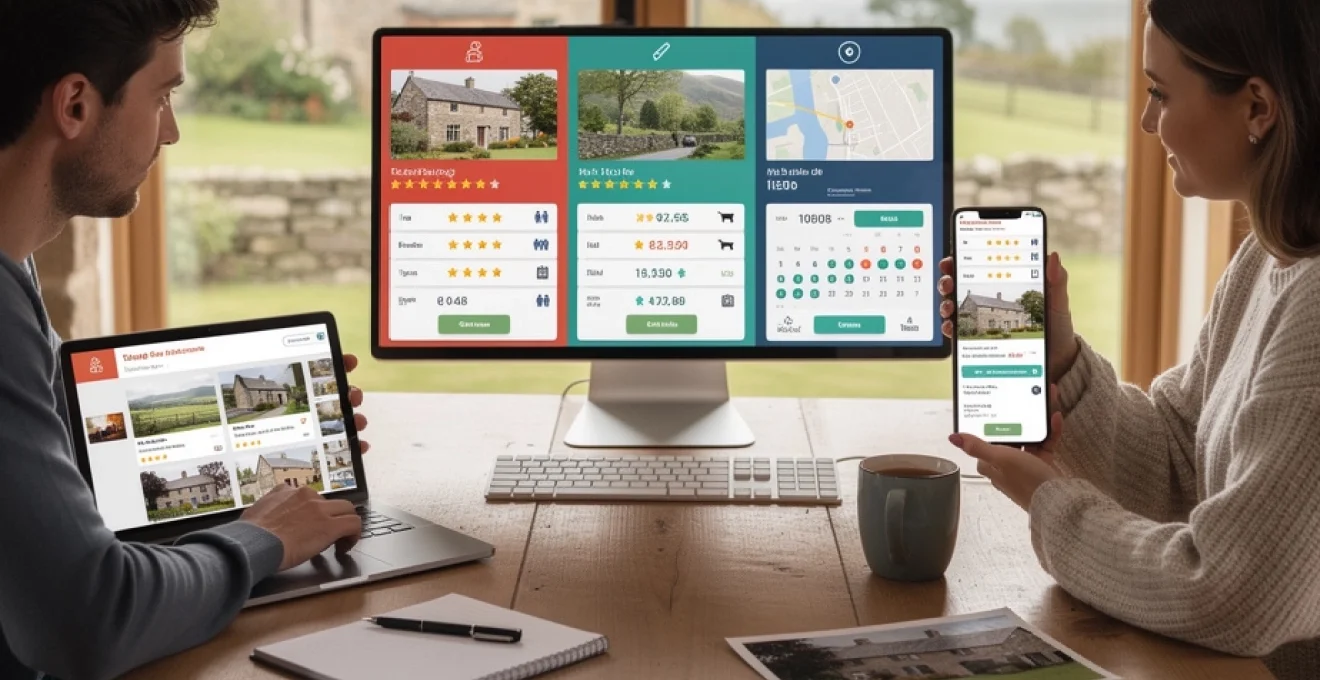
The digital transformation of holiday accommodation booking has fundamentally changed how travellers discover and secure cottage rentals. With more than 20 million properties listed across over 100 platforms globally, finding the perfect countryside retreat requires strategic navigation through an increasingly complex landscape of booking websites. The challenge isn’t simply locating available cottages—it’s identifying which platform offers the best combination of pricing transparency, property selection, and booking security for your specific needs. Understanding how to effectively compare these platforms can mean the difference between overpaying for a substandard experience and discovering exceptional value in a characterful property that exceeds expectations.
Understanding cottage booking platform ecosystems: airbnb vs vrbo vs booking.com
The cottage rental market has consolidated around three dominant platforms, each with distinct operational philosophies and target audiences. Airbnb pioneered the peer-to-peer accommodation model, democratising holiday lettings by enabling homeowners to list spare rooms or entire properties with minimal technical barriers. The platform’s strength lies in its extensive global inventory and intuitive mobile experience, though it has faced criticism for contributing to housing shortages in tourist hotspots like Barcelona, where short-term rentals were banned in 2021.
Vrbo (Vacation Rentals by Owner), part of the Expedia Group alongside HomeAway and Owners Direct, positions itself as a family-focused alternative emphasising whole-property rentals rather than shared spaces. This platform traditionally attracts property owners with established holiday letting businesses rather than casual spare-room hosts. Vrbo’s commission structure typically charges property owners annual subscription fees starting at £199, offering unlimited bookings without per-transaction charges—a model that benefits high-volume landlords but may inflate costs for occasional renters.
Booking.com, which owns Villas.com, approaches the cottage market from its hotel booking heritage, bringing sophisticated inventory management systems and extensive customer service infrastructure. The platform charges property owners approximately 15% commission per booking, a structure that ensures guests pay no additional booking fees. This transparency appeals to travellers wary of hidden charges, though the commission rate means properties must account for these costs in their base pricing.
Direct booking websites vs Third-Party aggregators: commission structures and pricing transparency
The fundamental distinction between booking directly with property owners and using aggregator platforms centres on cost structures and intermediary involvement. Direct booking websites operated by individual owners or small management companies like Sykes Cottages eliminate middleman commissions, theoretically enabling lower prices. Holiday Lettings (now integrated with TripAdvisor) charges property owners 3% plus VAT per booking whilst adding approximately 10% service fees for guests—a dual-commission model that can significantly inflate total costs compared to direct alternatives.
Third-party aggregators serve a crucial discovery function, consolidating thousands of properties into searchable databases with standardised presentation formats. These platforms invest heavily in search engine optimisation and paid advertising, driving customer acquisition that individual property owners cannot replicate cost-effectively. The trade-off becomes clear: you pay for convenience and selection breadth through either inflated base prices or explicit booking fees.
Payment gateway charges represent another often-overlooked cost differential. International bookings processed through platforms like HomeAway may incur currency conversion fees of 2-4%, whilst direct bookings using services like Stripe or PayPal typically charge flat transaction fees around 2.9% plus fixed per-transaction amounts. For a £1,500 week-long cottage rental, these seemingly small percentages translate to £30-60 variations between payment methods.
Sykes cottages, classic cottages, and independent property portfolios: platform specialisation analysis
Specialist cottage rental agencies like Sykes Cottages and Classic Cottages operate hybrid models, functioning simultaneously as property management companies and booking platforms. These organisations curate portfolios of typically 50-500 properties within defined geographic regions, offering standardised service levels including professional photography, linen provision, and 24-hour emergency support. Their business model relies on taking 20-25% commission from property owners whilst presenting guests with all-inclusive pricing.
The specialisation advantages become apparent when examining property quality consistency. Unlike Airbnb’s wildly variable standards, managed portfolios maintain baseline quality thresholds through regular property inspections
The specialisation advantages become apparent when examining property quality consistency. Unlike Airbnb’s wildly variable standards, managed portfolios maintain baseline quality thresholds through regular property inspections
, owner vetting, and stricter onboarding criteria. You are less likely to encounter misleading photography or inaccurate amenity lists, because these agencies depend on reputation and repeat business within relatively small cottage regions. Independent property portfolios, such as those run by boutique operators in the Cotswolds or Lake District, often go a step further, hand-picking characterful farmhouses, barns, and coastal cottages that fit a particular aesthetic or experience. When you compare websites for cottage stays, it is worth asking yourself whether you value a huge global inventory, or a smaller, carefully curated set of options with predictable standards.
This platform specialisation also affects how flexible your booking conditions and pricing structures will be. Larger brands like Sykes Cottages and Classic Cottages typically enforce set changeover days, minimum stays, and uniform cancellation policies across their inventory. Independent cottage agencies may be more willing to negotiate off-peak rates, midweek breaks, or bespoke arrangements for longer rentals. If you are planning a special occasion, such as a multi-generational family reunion, using a specialist cottage platform or independent portfolio can be like working with a tailor instead of buying off the rack: you get fewer options, but they are cut to fit your needs more closely.
User interface design and mobile responsiveness across leading cottage platforms
User interface design has a direct impact on how easily you can compare websites to book a cottage stay. A cluttered layout, slow loading images, or confusing calendar tools can make it much harder to identify the best value property. Airbnb and Booking.com have invested heavily in mobile-first design, meaning that their apps and responsive websites allow you to filter, bookmark, and message hosts from a smartphone with minimal friction. Vrbo, Sykes Cottages, and Classic Cottages have improved their interfaces significantly in recent years, but smaller independent agents may still lag behind with outdated search tools or static, non-responsive pages.
When assessing mobile responsiveness, pay attention to how many clicks it takes to perform core tasks such as adjusting dates, changing party size, or toggling key filters like “dog-friendly cottage with hot tub”. A good interface will behave like a well-organised kitchen: everything you need is reachable without endless rummaging. Look for platforms that remember your previous searches, offer clear breadcrumb trails, and display availability calendars without forcing constant page reloads. If you plan to research and book while commuting or travelling, prioritise cottage booking websites that offer robust, well-rated mobile apps with offline-friendly features such as saved favourites.
Accessibility and readability are also crucial components of interface quality. Small fonts, low-contrast text, or overly decorative layouts can make it tiring to scan multiple listings, particularly on smaller screens. Platforms that use simple iconography for amenities, clear price labels, and prominent map views allow you to compare cottage locations and facilities at a glance. You should also check whether the platform supports multiple languages and currencies, particularly if you are booking UK cottage holidays from abroad. A thoughtful interface will feel almost invisible, letting you focus your energy on evaluating properties rather than wrestling with the website.
Customer review authentication systems: TripAdvisor integration and verified booking feedback
Authentic customer reviews are one of the most powerful tools when you compare websites for cottage rentals. However, the value of a review depends entirely on how well the platform authenticates it. Booking.com and Airbnb rely heavily on “verified stay” reviews, meaning only guests who have completed a reservation can post feedback. Vrbo follows a similar model, although owners can sometimes import testimonials from previous offline guests, which can blur the verification line. Specialist agencies like Sykes Cottages and Classic Cottages typically operate closed review systems linked to completed bookings, reducing the risk of fabricated praise or malicious criticism.
TripAdvisor, integrated with platforms such as Holiday Lettings, offers a broader, destination-wide perspective but is more vulnerable to unverified contributions. While TripAdvisor has introduced checks and moderation, not every review is tied to a traceable booking. When you see a cottage listing that aggregates TripAdvisor badges or ratings, treat them as a useful starting point rather than a definitive verdict. Look for patterns over time: consistent mentions of cleanliness, thoughtful hosts, or issues like damp and road noise are harder to fake across dozens of reviews. A single glowing or scathing comment tells you far less than a long, stable average.
How can you use these systems to your advantage when choosing between cottage booking platforms? First, favour sites that clearly label which reviews are from verified stays and which are not. Second, prioritise recent reviews—properties change hands, are refurbished, or may decline in maintenance over the years. Third, examine responses from owners or agencies; professional, specific replies to criticism signal a higher level of accountability. Think of reviews as both a magnifying glass and a time machine: they show you the small details that photos miss and let you see how a cottage has performed across multiple seasons.
Advanced search filtering techniques for cottage accommodation discovery
Once you understand the ecosystem of cottage booking websites, the next step is learning how to use their search tools strategically. Advanced filtering allows you to cut through thousands of listings to find a cottage that genuinely fits your dates, budget, and preferences. Too many travellers rely on default search settings, scrolling through endless generic results instead of harnessing the powerful filters now available. Used well, these tools can turn the overwhelming process of comparing cottage booking websites into a focused, efficient search that takes minutes rather than hours.
Most major platforms offer variations of the same core filters: location, dates, party size, price range, and basic amenities. The real difference lies in how granular these filters are and how intuitively they can be combined. Airbnb, Booking.com, and Vrbo allow multi-filtering by property type (cottage, barn, lodge), facilities (hot tub, fireplace), and policies (pet-friendly, free cancellation). Specialist agencies and independent cottage websites often layer in region-specific criteria such as proximity to coastal paths, access to fishing rights, or on-site log burners. To compare websites effectively, test how quickly each one lets you go from a broad region like “Lake District” to a precise shortlist of three or four realistic options.
Geographic radius search parameters: cotswolds, lake district, and scottish highlands targeting
Geographic filtering is one of the most powerful ways to refine your cottage search, especially in dense holiday regions like the Cotswolds and Lake District. Some platforms use simple county or town-based searches, while others offer more advanced radius tools, allowing you to specify a distance from a particular village, postcode, or landmark. If you are attending a wedding in a specific Cotswold village, for example, a 5–10 mile radius search can save you hours of manual map-checking. Booking.com and Airbnb both provide strong map-based search interfaces, while Vrbo and Sykes Cottages offer detailed regional breakdowns that make it easier to target popular walking areas or lakeside locations.
For more remote destinations like the Scottish Highlands, map-based searches are even more critical. Addresses can be vague, and travel times can vary dramatically depending on road infrastructure and ferry connections. When you compare websites for Highlands cottage stays, prioritise those that overlay listings on accurate road maps and show approximate journey times to key hubs like Inverness, Fort William, or Skye bridges and ports. As a rule of thumb, always cross-check the map location against satellite view or a separate mapping app, because some platforms display approximate pins to protect owner privacy.
It can also be helpful to combine geographic filters with interest-based criteria. For example, if you are looking for a walking holiday in the Lake District, filter for properties within a short drive of major fells or national park boundaries, then narrow down by features like drying rooms, boot storage, and nearby pubs. In the Cotswolds, you might prioritise distance to market towns, cycle routes, or National Trust properties. Instead of treating geography as a simple “where on the map” question, think of it as the backbone of your cottage experience—the filter that shapes everything from your daily walks to grocery runs.
Amenity-specific filters: hot tubs, dog-friendly policies, and wood-burning stoves
Amenity filters can transform a generic holiday cottage into your ideal stay, especially for special occasions or specific lifestyle needs. Many travellers now search explicitly for “dog-friendly cottages with enclosed gardens” or “romantic cottages with hot tubs and wood-burning stoves”. Platforms like Airbnb and Booking.com include amenity tags for hot tubs, fireplaces, and pet policies, but specialist cottage agencies often go further with detailed notes on stair gates, boot rooms, log supplies, and garden fencing. When comparing websites, pay attention not just to whether an amenity filter exists, but how precisely it is defined and whether owners must verify these details during onboarding.
Dog-friendly policies are a good example of why detail matters. One platform might label a cottage as “pet-friendly” if dogs are allowed at all, while another requires owners to specify the maximum number of pets, restrictions on breeds, or whether dogs are allowed upstairs or on furniture. If you are travelling with a reactive or older dog, an enclosed garden and nearby walking routes away from busy roads may be just as important as the basic permission to bring pets. A robust cottage website will either provide this information in filters or encourage owners to describe it clearly in listing text.
Similarly, not all hot tubs or log burners are created equal. Some properties may charge extra for hot tub usage, limit operating hours, or require specific safety briefings, which should be mentioned in the listing or house rules. Wood-burning stoves might be decorative only, or owners may provide only a starter pack of logs. When you compare cottage booking sites, look for those that encourage owners to clarify these points, and always read the amenities section carefully rather than relying solely on filter icons. Think of amenity filters as signposts that point you in the right direction; it is still your job to read the fine print on the sign.
Occupancy calculators and bedroom configuration matching tools
For families and groups, the way beds and bedrooms are arranged can matter more than the raw number of sleeping spaces. Many cottage booking platforms now provide occupancy calculators and detailed bedroom configuration tools, allowing you to specify not just total guests, but how many adults, children, and infants will be staying. Airbnb and Booking.com generally handle maximum occupancy well, but specialist cottage agencies often outperform them when it comes to granular details like twin vs double beds, sofa beds, bunks, and ground-floor bedrooms. When you are comparing websites for larger cottage stays, this level of detail can be the difference between a comfortable holiday and a logistical headache.
Useful configuration tools typically show a room-by-room breakdown: “Bedroom 1: king; Bedroom 2: twin; Bedroom 3: single plus trundle; Lounge: double sofa bed,” along with information on en-suite vs shared bathrooms. Some platforms allow you to filter for accessible cottages with step-free access, downstairs bedrooms, or wet rooms, which is invaluable if you are travelling with older relatives or guests with mobility challenges. Treat these tools as you would a seating plan for an event: they help you see at a glance whether everyone will have a suitable place to sleep and get ready.
It is also worth checking whether the platform caps children and infants separately from adults within the occupancy calculator. A cottage that officially “sleeps 8” may include two sofa beds and count infants in travel cots towards that total, which can be misleading. If the sleeping arrangements look tight, message the owner or agency in advance to confirm how comfortable the space will feel at full capacity. Platforms that make this communication easy—and store conversations securely within the booking system—have a clear advantage when you are fine-tuning occupancy details.
Seasonal availability calendars and dynamic pricing algorithm comparisons
Availability calendars are at the heart of every cottage booking website, but not all calendars are equally informative. At a minimum, you should be able to see real-time availability for your chosen dates, along with clear indicators of minimum stay requirements and changeover days. Better platforms colour-code price bands across the year, letting you spot cheaper shoulder-season weeks or midweek breaks at a glance. When you compare cottage booking sites, look for calendars that update in real time and synchronise across multiple channels, reducing the risk of double bookings or outdated availability.
Dynamic pricing algorithms add another layer of complexity. Inspired by hotel and airline yield management, many platforms now adjust nightly rates based on demand, local events, lead time, and occupancy trends. Airbnb’s “Smart Pricing”, for example, suggests daily price changes to hosts, while some specialist agencies run their own revenue-management systems. This can work in your favour if you book well in advance for off-peak dates, but it can also inflate prices during bank holidays or school breaks. To navigate this, consider checking the same cottage across several platforms and on different days; variations in dynamic pricing can highlight where you are getting the best deal.
Seasonal availability also influences the type of promotions you will see. Some cottage websites offer “late deal” discounts for unbooked weeks close to arrival, while others provide early-bird savings for bookings made six to twelve months ahead. Think of the booking calendar as a stock market graph: high-demand dates behave like blue-chip stocks, rarely discounted, while shoulder-season weeks are more volatile and open to negotiation. If your dates are flexible, use calendar views across multiple platforms to spot patterns—then target periods where prices dip but weather and daylight hours are still favourable.
Price comparison methodologies and hidden cost identification
Comparing prices across multiple cottage booking websites is not as simple as matching the headline nightly rate. Each platform structures its fees differently, bundling or separating cleaning costs, service charges, and taxes. If you only look at base rates, you risk falling for artificially low prices that balloon at checkout. A more rigorous approach involves breaking down the total stay cost for identical or similar properties across two or three platforms, then assessing the value you receive for that final figure. This is where methodical travellers gain a clear advantage over impulsive bookers.
To build an accurate comparison, start by standardising your search parameters: same dates, same party size, and as close a match as possible in property type and location. Next, move all the way through to the final booking screen on each platform—without actually paying—to reveal mandatory fees such as cleaning, booking, and local taxes. Some sites will withhold certain charges until the last step, so stopping early can give a false impression of affordability. You might be surprised by how often a seemingly cheaper cottage ends up more expensive than a rival once every fee is included.
Base rate vs total cost analysis: cleaning fees, booking fees, and damage deposits
The single most important habit when you compare cottage booking websites is to differentiate between base rate and total cost. The base rate is the nightly or weekly price shown in search results; the total cost includes everything you are actually required to pay to stay. Airbnb, for example, commonly splits out cleaning fees and a service fee separate from the nightly price, while Booking.com tends to bundle more into the main rate but may add local taxes at checkout. Specialist agencies like Sykes Cottages and Classic Cottages usually present an inclusive weekly price, but may add booking protection or optional extras afterwards.
Cleaning fees can vary wildly, especially on peer-to-peer platforms where individual hosts set their own charges. A three-night cottage stay with a high cleaning fee can work out more expensive per night than a full week with a lower, more reasonable charge. Booking fees—often 5–15% of the rental amount—are another hidden cost that can make a big difference. Some direct-booking websites and independent agents avoid guest booking fees entirely, choosing instead to charge owners higher commissions. When price-comparing, always calculate the effective nightly rate including all compulsory fees, then compare like-for-like.
Damage deposits and security holds sit slightly outside the total cost equation, but they still matter. Some cottage websites take a refundable cash deposit, while others place a temporary hold on your card or charge a small, non-refundable damage waiver instead. A £300–£500 deposit may be acceptable for a week-long family stay, but it ties up your card limit and can create friction if refund processing is slow. When assessing value, factor in how comfortable you feel with the deposit structure and what it covers; a modest non-refundable waiver can sometimes be preferable to a large hold that takes weeks to return.
Currency conversion rates and international payment gateway charges
If you are booking a UK cottage from overseas, or reserving a European property from the UK, currency conversion and payment gateway fees can quietly add 2–5% to your bill. Some platforms allow you to choose between viewing prices in your home currency or the property’s local currency; others automatically convert at their own exchange rates, which may be less favourable than your bank’s. Airbnb, Booking.com, and Vrbo all process international transactions at platform-defined rates, sometimes adding a hidden margin on top of the underlying interbank rate.
To minimise these costs, check whether the platform lets you pay in the property’s native currency and use a card with low or zero foreign-transaction fees. You can then rely on your bank or card issuer’s exchange rate, which is often more transparent than the platform’s automatic conversion. For larger cottage bookings—say £1,500 for a week in a Lake District barn—the difference between a 1% and 4% conversion margin can be equivalent to the cost of a dinner out for your group. Consider it the digital equivalent of airport currency exchange: convenient but potentially expensive if you do not pay attention.
Payment gateways themselves may also impose fees, depending on whether you are using credit cards, debit cards, PayPal, or alternative methods like Apple Pay. Direct-booking cottage websites that use Stripe or similar processors typically pass on a flat percentage charge, baked into the rental price. Aggregator platforms may absorb some of these costs or blend them into their service fees. As a rule, avoid paying via bank transfer unless you fully trust the owner or agency and have verified their details independently; card payments and reputable gateways offer stronger consumer protection in the event of disputes or non-delivery.
Cancellation policy structures: flexible, moderate, and strict terms across platforms
Cancellation policies have become a key differentiator between cottage booking websites, especially in a post-pandemic world where travellers value flexibility. Most platforms now offer a spectrum of options, typically labelled flexible, moderate, and strict, but the exact definitions vary. Airbnb’s flexible policy might allow full refunds up to 24 hours before check-in, while a strict policy could restrict refunds to a small percentage if you cancel within a week or two. Vrbo, Booking.com, and specialist agencies all set their own frameworks, often allowing owners to choose from a menu of templates.
When you compare cottage booking sites, do not assume that identical labels mean identical terms. Always click through to read the specific cut-off dates, refund percentages, and conditions for your chosen listing. Some agencies also charge separate cancellation or amendment fees, even if a portion of the rental is refunded. Others offer enhanced protection products—effectively a type of basic travel insurance—that may cover certain reasons for cancellation, such as illness or severe weather. Consider how much flexibility you genuinely need: if your dates are tied to school holidays and non-refundable transport, a stricter policy may be acceptable in exchange for a lower price.
One practical approach is to use cancellation policies as a secondary filter during your search. Start by shortlisting cottages that meet your location, amenity, and price criteria, then narrow further by selecting only those offering flexible or moderate terms within your risk tolerance. Some platforms allow you to filter explicitly for “free cancellation” or “refundable stays”, which is particularly useful if your plans are not yet firm. Think of cancellation policies as the fine print on a contract: they may not be as exciting as hot tubs and sea views, but they can make a major difference to your stress levels if circumstances change.
Property listing quality assessment and photographic verification
Beyond pricing and policies, the quality of a cottage listing itself is a critical indicator of what you can expect on arrival. High-quality listings typically include multiple, well-lit photos covering all key rooms, exterior views, and any standout features such as gardens, hot tubs, or nearby vistas. Detailed descriptions should outline room sizes, bed types, heating systems, and quirks such as low beams or steep staircases, rather than relying on vague adjectives. When you compare websites for cottage stays, note which platforms enforce standards for photography and description length; specialist agencies often commission professional photography and copywriting, while peer-to-peer sites rely on owner initiative.
Photographic verification is especially important. Does the property appear consistent across multiple platforms? Are the timestamps recent, or do furnishings and decor look dated compared with recent reviews? Some websites, particularly premium cottage agencies, now provide virtual tours or 360-degree images that allow you to “walk through” the property before booking. Treat these visual tools as you would a viewing for a long-term rental: look for signs of damp, clutter, or awkward layouts that static, carefully cropped images might conceal. If you cannot see a clear photo of a room that matters to you—such as the bathroom or kitchen—consider it a red flag and ask for more information.
Listing text and floor plans provide another layer of verification. Platforms that encourage or require floor plans give you a much better sense of how the space flows, which is crucial for families with small children or guests with limited mobility. Pay attention to how honestly the property’s limitations are presented. A cottage that admits to being “cosy with low ceilings and narrow stairs” is more likely to set realistic expectations than one that overpromises with grandiose language. Cross-referencing the listing with guest reviews can help you identify discrepancies: if several guests mention road noise or a smaller-than-expected garden that the description glosses over, you may want to keep searching.
Secure payment gateways and booking protection schemes
Security should never be an afterthought when you book a cottage online. Established platforms like Airbnb, Booking.com, Vrbo, Sykes Cottages, and Classic Cottages all use secure payment gateways with encryption protocols (HTTPS, TLS) to protect your card data. They also act as intermediaries, holding funds until shortly before or after check-in, rather than passing money directly to hosts upon booking. This escrow-like structure provides an extra layer of protection in the event of non-delivery or fraud. When you are comparing websites, avoid any that ask you to pay via direct bank transfer outside the platform’s official payment system, as this dramatically reduces your ability to recover funds if something goes wrong.
Booking protection schemes vary by platform but generally include some combination of fraud protection, relocation assistance, and customer service support if the property is not as advertised. Airbnb’s “AirCover”, Vrbo’s “Book with Confidence Guarantee”, and Booking.com’s customer support framework are all designed to reassure guests that they will not be left stranded. Specialist cottage agencies often provide their own guarantees, sometimes including alternative accommodation if a property becomes unavailable at short notice. Read the terms carefully, noting what qualifies as “significant misrepresentation” and what evidence you would need to provide. Think of these schemes as safety nets: you hope never to use them, but you will be glad they exist if you fall.
To further safeguard your booking, consider paying with a credit card that offers chargeback rights or additional travel protection. In the UK, Section 75 of the Consumer Credit Act can sometimes apply to holiday accommodation purchases over £100 when paid directly by credit card, though coverage may be limited when intermediaries are involved. Keeping all correspondence within the platform’s messaging system also strengthens your position in any dispute, as it creates an auditable trail of promises and confirmations. Ultimately, the most secure cottage booking website is the one that combines robust technology, clear policies, and responsive human support—giving you confidence from the moment you pay until the day you check out.
Cross-platform analytics tools and cottage rental comparison extensions
With so many variables to juggle—location, amenities, pricing, and policies—it can be challenging to manually compare cottage booking websites. Cross-platform analytics tools and browser extensions can help by aggregating data and highlighting price differences for similar properties. Some travel metasearch engines act as cottage rental comparison tools, pulling listings from multiple platforms into a single interface. Others focus on hotels but increasingly include self-catering cottages and holiday homes, allowing you to see at a glance whether a property is cheaper on Booking.com, Expedia-affiliated sites, or a direct-booking agency.
Browser extensions and price-tracking tools can also be useful when you are planning well in advance. These tools monitor changes in nightly rates for your shortlisted cottages and alert you to drops or spikes, similar to flight price trackers. While fewer such extensions exist specifically for cottages than for flights, general-purpose price trackers can still capture some platforms, especially those with consistent URLs and transparent pricing structures. Using them is like having a personal assistant who keeps an eye on your top choices while you get on with your day, notifying you when a good deal appears.
Finally, do not underestimate DIY analytics. A simple spreadsheet comparing a handful of shortlisted cottages across two or three booking websites—recording total price, cancellation terms, deposit requirements, and key amenities—can quickly reveal which option offers the best overall value. It may feel old-fashioned compared with automated tools, but it forces you to compare like-for-like and avoid being distracted by slick interfaces or clever marketing. By combining platform-native filters, secure payment systems, and cross-platform comparison techniques, you put yourself in the strongest possible position to book a cottage stay that aligns with your budget, expectations, and travel style.